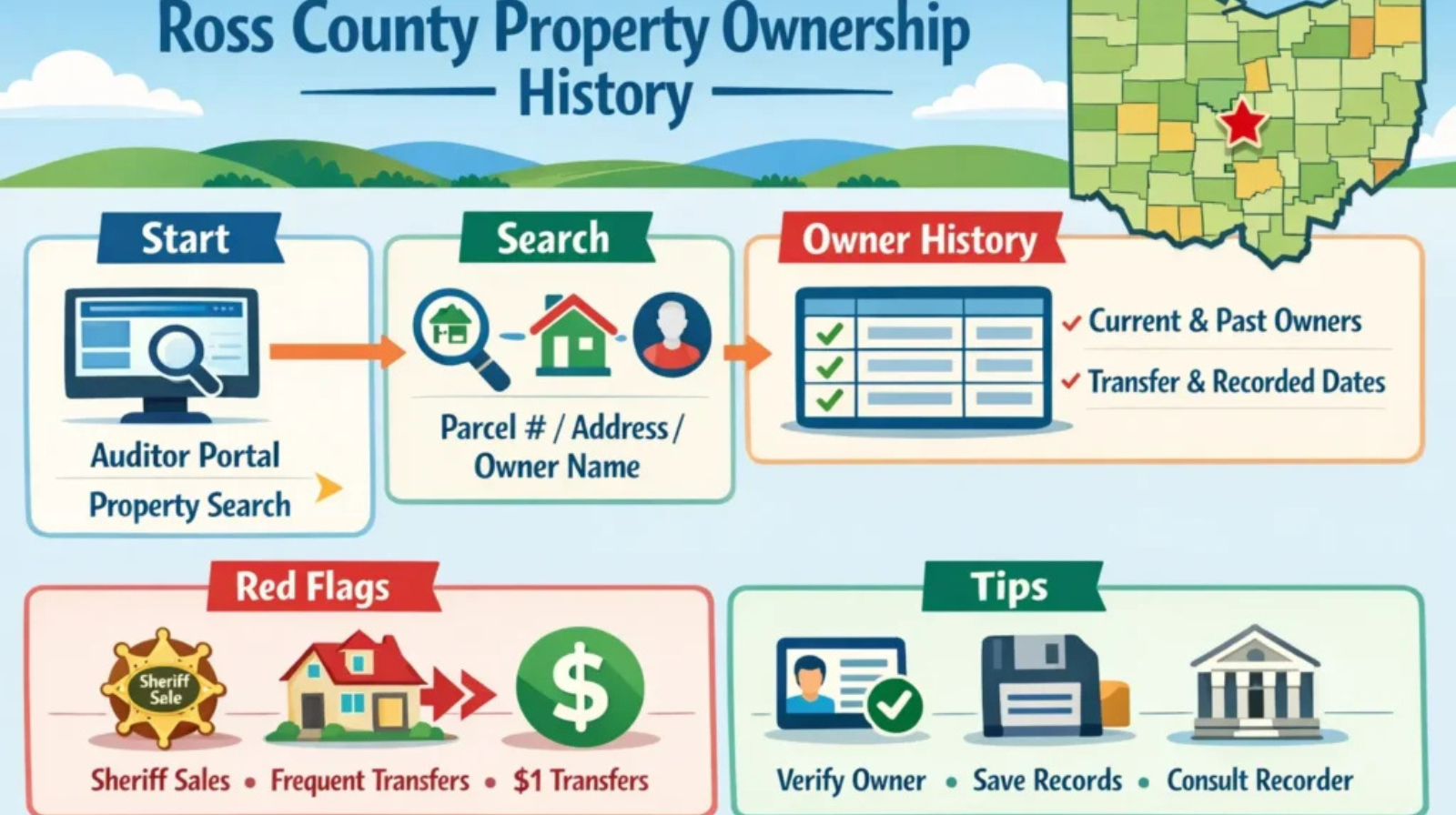
Ross County property ownership history is one of the most important — and most overlooked — pieces of information for anyone buying, selling, inheriting, or researching real estate in Ross County, Ohio. Whether you are a first-time homebuyer trying to verify a clean title, a genealogist tracing a family’s land through generations, or an investor evaluating risk on a parcel, understanding how to find and read property ownership records is an essential skill.
Fortunately, Ross County maintains excellent public records. Between the Auditor’s online portal, the Recorder’s deed database, GIS mapping tools, and historical courthouse archives, you have everything you need to trace any property’s full ownership chain — in many cases for free and without leaving your home.
This comprehensive guide walks you through all 7 steps — from pulling the parcel number to hiring a professional title company for legally verified searches — so you can find complete Ross County property ownership history quickly and confidently.
Why Ross County Property Ownership History Matters
Before jumping into the steps, it is worth understanding exactly why researching Ross County property ownership history matters — and who needs it most.
Property records are among the most powerful public documents available. They reveal who has owned a piece of land, when ownership changed hands, how much was paid, whether any mortgages or liens are attached, and whether any legal disputes have affected title. This information protects buyers, informs investors, and helps families understand what they have inherited.
Here are the most common reasons people research Ross County property records:
- Real Estate Buyers: Verify clean title before closing to avoid inheriting unpaid liens, disputes, or encumbrances from previous owners.
- Heirs and Estate Attorneys: Establish a legal chain of title during probate to confirm what a deceased person actually owned and how it should be distributed.
- Genealogists and Historians: Trace a family’s property ownership across decades or centuries to reconstruct life history and migration patterns.
- Real Estate Investors: Assess title risk, review previous sale prices, and identify distressed or motivated sellers.
- Neighbors and Adjacent Property Owners: Clarify boundary disputes, easements, and rights-of-way recorded in historical deeds.
- Journalists and Researchers: Investigate property transfers connected to public figures, corporations, or legal cases.
| Pro Tip: Even if you are just curious about your own home’s history, researching Ross County property ownership history can reveal fascinating stories — previous owners, original purchase prices, and how the land has changed over time. |
Step 1: Start With the Ross County Auditor’s Property Search Portal
The very first step in any Ross County property ownership history search is the Ross County Auditor’s official online property search portal. This free, publicly accessible database is your gateway to current ownership information and the all-important parcel number you will need for every subsequent step.
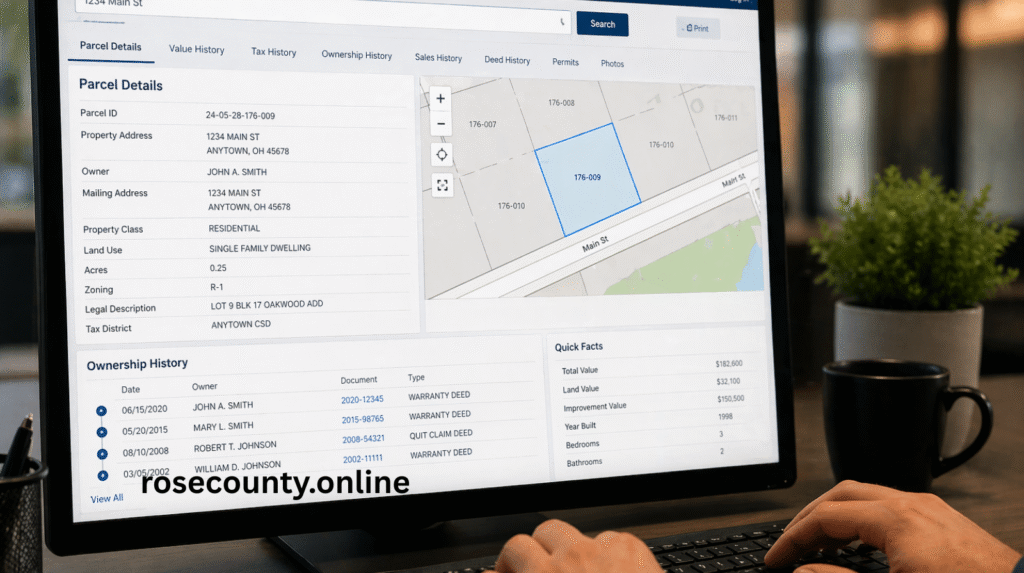
What You Can Find on the Auditor’s Portal
The Ross County Auditor’s portal gives you instant access to:
- Current owner’s full name and mailing address
- Permanent Parcel Number (PPN) — the unique ID for every piece of land in the county
- Property address and legal description
- Assessed value and market value (updated annually)
- Property tax payment history — whether taxes are current or delinquent
- Land use classification (residential, commercial, agricultural, etc.)
- Acreage and lot dimensions
- Recent transfer dates and sale prices
How to Use the Auditor’s Portal Step by Step
- Visit the official Ross County Auditor’s website (search ‘Ross County Auditor Ohio’ to find the current URL).
- Click on the ‘Property Search’ or ‘Real Estate Search’ section.
- Enter the property address, the current owner’s name, or the parcel number if you already have it.
- Review the results and click on the correct property to see full details.
- Write down or screenshot the Permanent Parcel Number — you will use this in every step that follows.
The Auditor’s portal is updated regularly and reflects the most current ownership on record. However, it typically shows only the current owner and recent transfers — not the full Ross County property ownership history going back decades. For that, you will need the Recorder’s Office.
Step 2: Search the Ross County Recorder’s Office for Deed Records
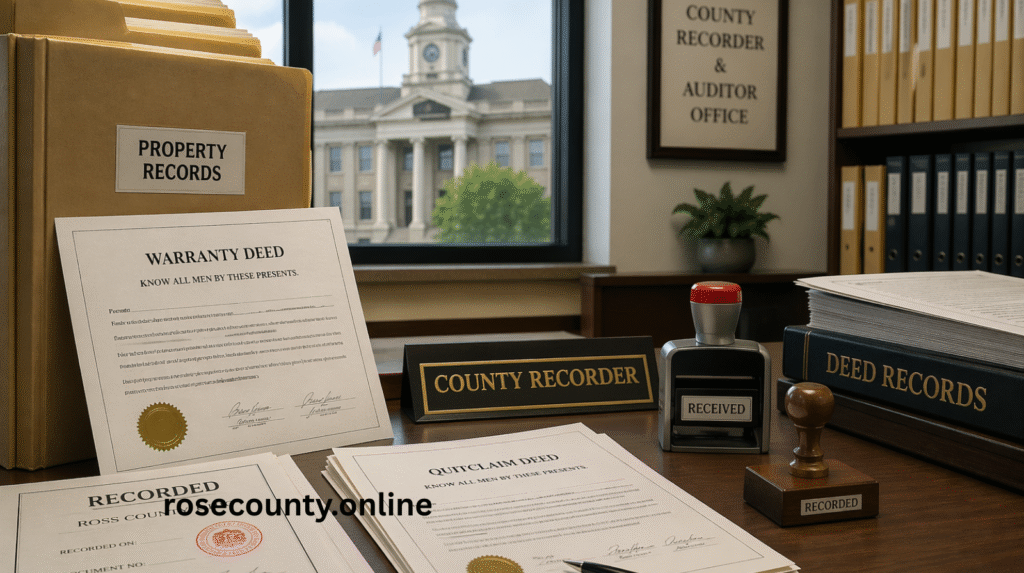
The Ross County Recorder’s Office is the official repository for all recorded land documents in the county. This is where the true depth of Ross County property ownership history is stored — every deed, mortgage, lien, and transfer recorded since the county’s founding in 1798.
Types of Documents Recorded at the Ross County Recorder’s Office
| Document Type | What It Shows | When It Applies |
| Warranty Deed | Full ownership transfer with seller’s guarantee of clean title | Standard property sales |
| Quitclaim Deed | Transfer of whatever interest seller has — no title guarantee | Family transfers, divorces |
| Sheriff’s Deed | Court-ordered transfer after foreclosure or judgment | Foreclosure sales |
| Executor’s Deed | Transfer from deceased person’s estate to heir or buyer | Probate and estate sales |
| Survivorship Deed | Transfers automatically to surviving co-owner upon death | Joint ownership |
| Mortgage Records | Lien placed on property as loan collateral | Purchase and refinance loans |
| Release of Mortgage | Lien removed after loan is paid in full | Post-payoff records |
| Easement Agreements | Grants access rights over property to another party | Utilities, driveways, paths |
How to Search Deed Records Online
The Ross County Recorder’s Office maintains an online deed search database that covers most transactions from the late 20th century onward. Here is how to use it effectively:
- Visit the Ross County Recorder’s official website and navigate to the deed or land records search.
- Search by Grantee (buyer/current owner) name to find when the current owner acquired the property.
- Then search by Grantor (seller) name — which will be the previous owner — to trace the chain back one more step.
- Repeat this process: each grantor becomes your next grantee search, stepping back in time link by link.
- For each deed found, record the Book number, Page number, recording date, grantor, grantee, and consideration (sale price).
| Important: Tracing Ross County property ownership history through deeds means working backwards. Start with today’s owner and follow each seller back through time until you reach the original land patent or your research goal. |
Understanding the Chain of Title
The ‘chain of title’ is the sequential record of every ownership transfer for a property. A clean, unbroken chain of title is what title insurance companies look for to confirm that the current owner has the legal right to sell. Gaps in the chain — periods where ownership is unclear or unrecorded — are red flags in any Ross County property ownership history search.
Step 3: Use the Ross County GIS Mapping System
Geographic Information System (GIS) mapping tools give you a powerful visual layer for your Ross County property ownership history research. Instead of searching by name or address, GIS lets you click directly on a map to pull up parcel information.
What GIS Mapping Offers for Property Research
- Visual parcel boundaries overlaid on current aerial photography
- Instant ownership lookup — click any parcel to see owner name and PPN
- Neighboring parcel identification — useful for boundary and easement research
- Historical aerial imagery in some systems — see how land use has changed over time
- Ability to measure lot dimensions and acreage directly on the map
- Zoning overlays — understand current land use regulations
GIS tools are especially valuable when you do not know the exact address of a property — perhaps you are researching a vacant lot, agricultural land, or an undeveloped parcel. Simply navigate the map to the location, click the parcel, and retrieve the PPN to begin your full research.
GIS data is also useful for verifying that the legal description in a deed matches the actual physical parcel. Discrepancies between recorded legal descriptions and actual boundaries are an important finding in thorough Ross County property ownership history research.
Step 4: Access Ohio’s Statewide Property Records Through the Auditor of State
Ohio maintains a statewide property records aggregator through the Ohio County Auditors’ Association and related state portals. This resource compiles data from all 88 Ohio counties — including Ross County — into a single searchable interface.
When to Use Statewide Ohio Property Records
The statewide search is particularly useful for Ross County property ownership history research when:
- You want to compare a Ross County property with similar properties in neighboring counties (Pickaway, Hocking, Pike, Highland, or Fayette).
- You are researching a property whose county location you are not entirely certain of — perhaps near a county line.
- You need to do quick initial lookups across multiple Ohio counties as part of broader research.
- You want to cross-reference data you found on the local Ross County portal against the state-level records for consistency.
Statewide tools will redirect you to Ross County’s specific records once you identify the right property. They do not replace the depth of the local Recorder’s deed records but serve as an excellent starting or cross-referencing point for Ross County property ownership history research.
Step 5: Visit the Ross County Courthouse for Historical Deed Books
For Ross County property ownership history that extends back before the digital era — typically anything prior to the 1980s — you will need to visit the Ross County Courthouse in Chillicothe, Ohio in person. The Recorder’s Office maintains a complete physical archive of deed books going back to the county’s founding.
What You Will Find in the Physical Archive
- Grantor-Grantee Index Books: Large bound volumes listing all property transactions alphabetically by seller (Grantor) and buyer (Grantee). Organized by time period — you search the appropriate date range to find deed book and page references.
- Deed Book Volumes: The actual recorded deeds — sometimes handwritten, sometimes typed — containing the full legal text of every property transfer.
- Plat Books: Survey maps showing how large tracts of land were subdivided into individual lots over time.
- Mortgage Record Books: Historical mortgage and lien records predating digital systems.
How to Research Historical Records at the Courthouse
- Identify the time period you want to research (for example: who owned the property from 1920 to 1950).
- Pull the Grantor-Grantee Index volumes covering that time period from the shelves.
- Search alphabetically for the property owner’s name in the Grantee index to find when they acquired the property — the index will list the deed book number and page.
- Retrieve the corresponding deed book volume and turn to the listed page to read the full deed.
- Note the Grantor name on that deed — this becomes your next search name in the Grantee index for the prior time period.
- Repeat until you have traced the ownership back as far as needed.
| Practical Tip: Most Ross County Courthouse offices allow you to photograph deed book pages with your smartphone. Bring a phone or camera, wear comfortable shoes, and budget several hours for in-depth historical Ross County property ownership history research. |
Step 6: Search Early Land Grant Records for Ross County’s Oldest Properties
Ross County was established in 1798, and its earliest Ross County property ownership history connects directly to federal land grants and the Virginia Military District — making it one of the most historically interesting counties in Ohio for property researchers.
The Bureau of Land Management GLO Records Database
The U.S. Bureau of Land Management (BLM) maintains a free online General Land Office (GLO) Records database that contains the original federal land patents issued to settlers and veterans across Ohio and other public land states. For Ross County, this means you can trace a property back to its very first private owner — the individual who received the land directly from the federal government.
The GLO database is searchable by:
- Patentee (recipient) name
- County and state
- Land description (Township, Range, Section)
- Patent date
The Virginia Military District — A Unique Layer of Ross County History
A significant portion of Ross County falls within Ohio’s Virginia Military District (VMD) — a tract of land set aside by the federal government to fulfill land bounty promises made to Virginia soldiers who served in the Revolutionary War. These grants, issued from the 1780s through the early 1800s, are a unique and fascinating layer of Ross County property ownership history not found in the standard rectangular survey system used elsewhere in Ohio.
VMD records are irregular in shape and location — they do not follow the neat Township-Range-Section grid of most Ohio surveys. Researching VMD land requires accessing special indexes and survey records held at:
- The Ohio History Connection (Columbus, Ohio): Formerly the Ohio Historical Society, this archive holds extensive VMD survey records, military warrants, and early Ross County deed abstracts.
- The Library of Virginia (Richmond, Virginia): For the original military warrants and Virginia state grants that preceded the federal patents.
- National Archives: For federal-level bounty land warrant records connecting veterans to their Ohio land grants.
| Did You Know? Some Ross County properties can be traced in an unbroken chain of title from a Revolutionary War veteran’s land grant in the late 1700s all the way to a present-day owner — more than 225 years of recorded Ross County property ownership history in a single chain. |
Step 7: Hire a Title Company or Abstractor for a Verified Chain of Title
For legally sound, professionally verified Ross County property ownership history — particularly when you are purchasing property, refinancing, or resolving a legal dispute — hiring a licensed title company or professional abstractor is the right choice. While the previous six steps are excellent for independent research, a professional title search delivers a legally defensible, comprehensive result.
What a Professional Title Search Delivers
- Full chain of title from current owner back to original patent or a specified search period
- Complete lien search — open mortgages, judgment liens, tax liens, mechanic’s liens
- Easement and right-of-way identification
- Restrictive covenant review
- Probate and estate record checks
- Bankruptcy filing search
- Federal and state tax lien search
- Title insurance eligibility determination
When You Should Use a Professional
You should always hire a professional title company for Ross County property ownership history verification when:
- You are purchasing any real property — residential, commercial, or agricultural
- You are refinancing a mortgage and the lender requires a title update
- You are involved in a boundary dispute or quiet title action
- The property has a complex ownership history with multiple transfers, estates, or legal proceedings
- You need title insurance as part of a real estate transaction
- You are an heir or executor settling an estate and need clear title documentation
What to Expect From a Title Search in Ross County
Local title companies in Chillicothe, Ohio specialize in Ross County records and have established relationships with the Recorder’s Office and courthouse. A standard residential title search typically takes two to five business days and involves a fee that varies based on the search period requested and the complexity of the title history.
Quick Reference: All Ross County Property Ownership History Resources
| Resource | Best For | Cost | Access Method |
| Ross County Auditor Portal | Current owner, tax data, PPN | Free | Online |
| Ross County Recorder’s Office | Deeds, mortgages, transfers | Free (basic) | Online + In Person |
| Ross County GIS Mapping | Visual parcel identification | Free | Online |
| Ohio Statewide Auditor Tool | Cross-county comparison | Free | Online |
| Ross County Courthouse Archives | Pre-1980s historical records | Free | In Person Only |
| BLM GLO Records Database | Original federal land patents | Free | Online |
| Ohio History Connection | VMD grants, early deeds | Varies | In Person / Online |
| Professional Title Company | Legally verified chain of title | Paid (varies) | Hired Service |
Related Guides and Resources for Ohio Property Research
If you found this guide helpful, the following related topics will deepen your understanding of Ohio property records and real estate research:
- How to Read Ohio Property Tax Records — Understanding millage rates, exemptions, and delinquency
- Ohio Probate Property Records — Tracing estates and inheritance transfers in Ohio courts
- Understanding Ohio Legal Descriptions — Township, Range, Section, and metes-and-bounds explained
- How to Search Ohio Court Records for Property Disputes — Quiet title actions, foreclosures, and partition suits
- Ohio Property Tax Delinquency — What happens when taxes go unpaid and how it affects title
Final Thoughts on Ross County Property Ownership History
Researching Ross County property ownership history is a systematic, step-by-step process that anyone can follow with the right guidance. By starting with the Auditor’s portal to capture the Permanent Parcel Number, moving through the Recorder’s deed database to trace the chain of title, and going deeper into courthouse archives and historical land grant records when needed, you can build a complete and reliable ownership history for virtually any property in the county.
Whether you are a buyer protecting your investment, an heir untangling an estate, a researcher following a family’s land through generations, or simply curious about the history beneath your feet, these 7 proven steps give you everything you need to find Ross County property ownership history — fast, thoroughly, and in most cases completely free.
For simple research tasks, the online portals will get you most of the way there. For complex title histories, gaps in the chain, or legally binding purposes, do not hesitate to engage a professional title company based in Chillicothe who specializes in Ross County property ownership history and records. The investment in professional research is always worth it when significant money or legal rights are at stake.
Conclusion:
Researching property ownership history in Ross County is a vital step for anyone involved in real estate, whether you are a buyer, seller, investor, or simply verifying property details. Accurate ownership records provide a clear picture of who has held the property over time, helping you identify legal ownership, past transfers, liens, and any potential disputes. This transparency not only protects you from future complications but also builds confidence in your decisions.
By utilizing official resources such as the Ross County Auditor’s Office for property values and tax records, and the Ross County Recorder’s Office for deeds and legal documents, you can access reliable and up-to-date information. These offices play a key role in maintaining public records, ensuring that all property transactions are properly documented and accessible to the public.
In today’s digital age, many of these records are available online, making the search process faster and more convenient. However, it is still important to cross-check information and understand how to read official documents correctly. Taking a careful and informed approach can save time, prevent costly mistakes, and provide peace of mind.
In conclusion, exploring property ownership history in Ross County is not just a routine task—it is a smart and necessary step that ensures transparency, legal security, and better decision-making in any property-related matter.
Frequently Asked Questions About Ross County Property Ownership History
How far back do Ross County property records go?
Ross County property records extend back to the county’s founding in 1798. The earliest records connect to the Virginia Military District grants and federal land patents from the late 1700s and early 1800s. The physical deed books at the Ross County Courthouse cover the full span of the county’s history, while online databases typically cover the past few decades of Ross County property ownership history.
Are Ross County property records free to access?
Yes — most Ross County property records are free to access. The Auditor’s portal, GIS system, Recorder’s online database (for basic searches), and BLM GLO Records are all free to use. In-person access to courthouse deed books is also free. The only situation that involves significant cost is hiring a professional title company for a certified search.
What is a Permanent Parcel Number and why do I need it?
A Permanent Parcel Number (PPN) is the unique numeric identifier assigned to every parcel of land in Ross County by the Auditor’s Office. It is the master key that unlocks records across every database and system — Auditor, Recorder, GIS, courts, and tax records. Always retrieve the PPN first when beginning any Ross County property ownership history research, as it will make every subsequent step faster and more precise.
Can I find out who owned a Ross County property 100 years ago?
Yes, absolutely. For properties with ownership history going back 100 or more years, you will need to use the physical Grantor-Grantee index books and deed volumes at the Ross County Courthouse. Deed records from the early 1900s, 1800s, and even the late 1700s are preserved in these archive books. With patience and the right search technique, you can trace any property’s Ross County property ownership history back to its very first private owner.
What is the Virginia Military District and does it affect my Ross County property?
The Virginia Military District is a tract of land in south-central Ohio — covering much of Ross County — that was reserved by Congress to fulfill land bounty promises made to Virginia’s Revolutionary War veterans. If your property falls within the VMD, its original chain of title will be different from standard surveyed townships and may connect back to a Revolutionary War land warrant. Identifying whether your property is in the VMD is an important part of thorough Ross County property ownership history research for older parcels.
How do I find liens and encumbrances on a Ross County property?
Liens and encumbrances — including mortgages, judgment liens, tax liens, and mechanic’s liens — are recorded at the Ross County Recorder’s Office and can be searched through the same deed record database. For a comprehensive lien search, especially in connection with a real estate purchase, a professional title company will search multiple public records databases simultaneously to ensure nothing is missed.